


A shaded-pole fan motor and a capacitor-start fan motor can sit in the same stamped housing, drive the same blade, and still behave like different machines at startup. The practical verdict is simple: for small, low-static-pressure fans that run for long periods, a shaded-pole motor is usually the lower-cost and lower-maintenance choice; for high-static-pressure, high-inertia, or hard-starting fans, a capacitor-start motor is the better match when the capacitor, switch and duty cycle are specified correctly.
Choose it when: the fan starts against low static pressure, the blade is light, the annual run time is high, and the buyer wants the fewest service parts.
Choose it when: the fan must overcome duct resistance, heavy blades, cold bearings, or a high-inertia load at every start.
A shaded-pole motor is the simplest single-phase AC induction motor used in fans. The stator has salient poles, and part of each pole face is encircled by a shorted copper ring, usually called a shading ring or shading coil. When AC current energizes the main winding, the flux in the shaded portion lags the flux in the unshaded portion. That phase displacement is enough to produce a weak rotating field, so the rotor accelerates from standstill without a separate start winding, capacitor or switch.
The ring is not a wear item in the same sense as a capacitor, but it must be properly swaged and positioned during lamination stacking. A cracked, loose or poorly formed shading ring changes the start behavior, increases slip, and can raise magnetic noise. In a small fan, the symptom often appears as poor acceleration at low voltage or a faint hum that changes pitch when the blade is blocked. Because the starting field is weak, the motor cannot produce high torque at breakaway. That is not a manufacturing defect; it is the physics of the design.
The simple construction buys cost, parts count and service access. There is no electrolytic start capacitor to dry out, no centrifugal switch to arc, and no relay to fail. The winding is usually a concentrated coil around each salient pole, which keeps copper and labor content low. For a bathroom exhaust fan, a small desk fan, or a low-pressure wall fan that runs for hours at a time, those advantages are real. The trade-off is low starting torque and modest efficiency, so the motor is best matched to a light blade and a fan curve that does not demand a steep pressure rise.
Our shaded-pole motor family is built around that logic: compact frames, stable shading-ring geometry, and winding options that match the fan curve rather than a generic catalog rating.
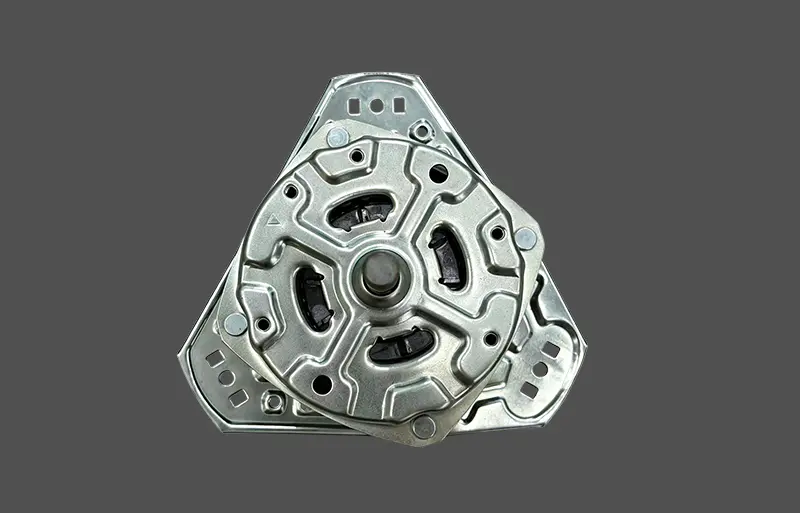 TY-041 Shake-Head Fan AC Motor SeriesA compact single-phase shaded-pole fan motor for oscillating shake-head platforms, with adaptable frame, shaft and mounting interface and ISO 9001-listed production.View Product →
For oscillating fan platforms, the TY-041 series is one compact fan motor format that shows how the frame, shaft and mounting interface can be adapted without changing the basic shaded-pole starting principle.
A capacitor-start motor also uses a single-phase AC supply, but it creates a stronger rotating field by adding an auxiliary or start winding displaced in space from the main winding. A start capacitor is placed in series with that auxiliary winding. The capacitor shifts the current phase so the two windings produce a field with a much larger starting component. Once the rotor reaches roughly 70 to 75 percent of synchronous speed, a centrifugal switch or an electronic relay disconnects the start circuit. The motor then runs on the main winding alone.
The distinction matters because the names are often used loosely. A capacitor-start motor uses a start capacitor that is removed after acceleration. A permanent split capacitor motor, usually called a PSC motor, keeps a run capacitor in the circuit continuously and has no centrifugal switch. Many fans use PSC motors, not capacitor-start motors. If a fan has only a run capacitor and no switch, it is PSC. This is why a specification that says “capacitor motor” can point to two different starting methods with very different torque, noise and service profiles.
For variable-speed fan designs, a PSC fan motor is often the more practical AC choice because the run capacitor stays in circuit and the motor can tolerate a wider speed range without a switch cycling on every start. A capacitor-start motor is selected when the fan must produce high breakaway torque, not when the fan must run quietly across a deep speed range.
The switch is mechanical. It opens and closes every time the fan starts and stops. Contacts can pit, dust can bridge the gap, and humidity can corrode the mechanism. A switch that fails closed keeps the start winding energized, which overheats the auxiliary winding. A switch that fails open prevents the motor from accelerating. Electronic relays remove the mechanical contact but add their own failure points. In a fan that starts several times an hour, the switch duty cycle belongs in the specification, not in the service manual after the fact.
The motor does not start a fan; it starts a fan system. The required torque is set by the blade inertia, the bearing condition, the air density, and the static pressure at the inlet and outlet. A fan that starts against a closed damper, a long duct run, or a filter loaded with dust needs more breakaway torque than the same fan starting in free air. A shaded-pole motor may spin a light axial blade in free air without trouble, yet stall on a cold morning when the bearing grease is stiff and the duct system is at high static pressure.
| Characteristic | Shaded-pole motor | Capacitor-start motor | PSC motor, for context |
|---|---|---|---|
| Starting torque | Low, often about 25 to 50 percent of full-load torque | High, often about 150 to 300 percent of full-load torque | Moderate, typically lower than capacitor-start |
| Starting parts | Shading ring only | Start capacitor plus centrifugal switch or relay | Run capacitor, no start switch |
| Full-load efficiency | Low, often 20 to 40 percent in small fan frames | Higher, often 55 to 70 percent depending on size | Moderate to good, often 50 to 65 percent |
| Typical fan fit | Small axial fans, low-pressure exhaust, light blades | High-static-pressure blowers, heavy blades, hard starts | Quiet fans, variable-speed AC fans, continuous duty |
| Service profile | Fewest start-related parts | Capacitor and switch need inspection | Run capacitor is a long-term service item |
Those numbers explain a common field complaint. A replacement shaded-pole motor may look identical to the original, yet the fan fails to start because the replacement has a slightly different rotor resistance, shading-ring width, or bearing preload. The motor is not “weak” in a generic sense; it is mismatched to the fan’s breakaway torque. A capacitor-start motor solves that problem by creating a stronger starting field, but it introduces a capacitor and a switch that must be rated for the same number of starts.
Efficiency is not just a catalog number. It changes the heat that stays inside the motor, the winding temperature, the bearing temperature, and the amount of current the fan draws from the supply. A shaded-pole motor has a low power factor and a high slip, so a large share of the input energy becomes heat rather than shaft power. A capacitor-start motor runs as a better-balanced induction motor after the start circuit disconnects, so its full-load efficiency is usually higher. The gap is most visible in small frames where the shaded-pole design is common.
Illustration: a fan that delivers 40 W of shaft power at 30 percent efficiency draws about 133 W. The same 40 W at 55 percent efficiency draws about 73 W. The difference is about 60 W. At 8 hours a day and 365 days a year, that is roughly 177 kWh. At 0.15 per kWh, the annual difference is about 26.50. The exact numbers depend on the fan curve and tariff, but the direction is clear: a low-efficiency motor can cost more in electricity than the purchase-price difference suggests.
Heat is the second cost. A shaded-pole motor that runs at low efficiency in a sealed fan housing has less thermal margin. The winding insulation may be adequate at rated load, but a blocked filter, a high ambient temperature, or a low-voltage supply can push the temperature rise beyond the design limit. A capacitor-start motor with higher efficiency has more thermal headroom, yet its start capacitor may be the first component to degrade in a hot enclosure. The enclosure design, the capacitor temperature rating, and the duty cycle have to be reviewed together.
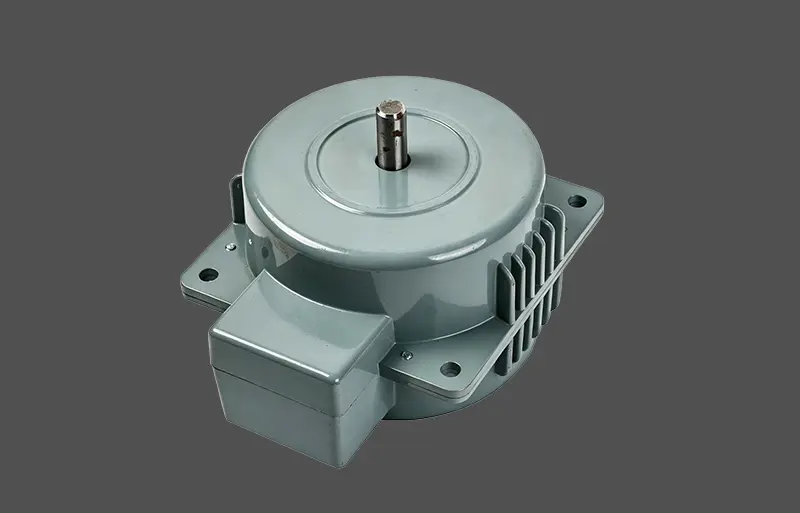 TY-068 High-Efficiency Low-Noise Fan MotorA low-noise, low-vibration motor for commercial and industrial fan builds, with customizable installation dimensions and stable speed for noise-sensitive exhaust-airflow applications.View Product →
For exhaust fan builds, the TY-068 series is one example of how a fan motor frame can be matched to a specific airflow path, mounting pattern and insulation requirement rather than treated as a generic interchangeable part.
A capacitor-start fan motor has two service items that a shaded-pole motor does not: the start capacitor and the switch. The capacitor is an electrolytic component in many low-cost designs. Its life is shortened by high ambient temperature, high ripple current, and frequent starts. A capacitor that loses capacitance may still let the fan start unloaded, but the fan will stall under a closed damper or a high-static-pressure condition. A capacitor that fails short can overheat the start winding before the switch opens.
| Service issue | Shaded-pole motor | Capacitor-start motor | What to check first |
|---|---|---|---|
| Fan will not start | Low starting torque, stiff bearing, blocked blade, low voltage | Failed start capacitor, open switch, broken start winding | Measure supply voltage, capacitor capacitance, switch continuity |
| Motor hums but does not accelerate | Shading ring damage, shorted turn, mechanical bind | Switch stuck open or capacitor lost capacitance | Isolate the load and test the start circuit |
| Overheating at rated load | Low efficiency, blocked airflow, high ambient | Start circuit not disconnecting, wrong capacitor | Check current, switch action and capacitor rating |
| Noise or vibration | Magnetic noise, loose shading ring, bearing wear | Switch chatter, capacitor hum, bearing wear | Compare noise at start and at steady speed |
Service access should be part of the fan design review. If the capacitor sits behind a sealed motor cover, a planned replacement becomes a motor replacement. If the switch is buried under a mounting bracket, a five-minute diagnosis becomes a full teardown. Shaded-pole motors avoid those access issues, but they can still fail from bearing wear, winding overheating or shading-ring damage. The right question is not “which motor has no service items?” but “which service items can the installation tolerate?”
Noise comparisons are often oversimplified. A shaded-pole motor can be quiet in a small fan because it has no switch click and no capacitor hum, but it can also produce a strong magnetic hum at twice the line frequency. The shading ring creates an asymmetric field, and the rotor slot harmonics can couple into the fan housing. A capacitor-start motor produces a smoother rotating field during normal running, but the centrifugal switch gives a mechanical click at every start, and the start capacitor can produce a brief electrical transient. After the switch opens, the motor is usually quieter than a shaded-pole motor of the same quality, provided the blade and housing are not amplifying a structural resonance.
At low speed, a shaded-pole motor loses torque quickly. Voltage reduction may slow the fan, but the motor also loses its ability to overcome bearing friction and duct pressure. A capacitor-start motor is not designed for continuous low-speed operation through voltage control; the start switch may not engage correctly, and the motor may overheat. A PSC motor is better suited to AC speed control because the run capacitor remains in circuit and the motor can tolerate a wider slip range. An electronically commutated motor is better again for deep speed control, but it changes the cost structure and the control electronics.
A shaded-pole fan can be controlled with a simple triac dimmer or a multi-tap transformer, but the fan curve changes with voltage and the motor may stall at the lowest setting. A capacitor-start motor should not be used as a frequently started variable-speed drive. The switch and capacitor are selected for a finite number of starts, and short cycling shortens their life. If the application needs ten starts an hour and a 30 percent speed turndown, the honest answer is that neither motor is the ideal choice; a PSC or EC motor should be evaluated before the fan housing is frozen.
The application matrix is more useful than a generic “good or bad” label. A shaded-pole motor is a strong fit where the fan curve is flat, the blade is light, and the annual run time is long enough that parts count matters more than efficiency. A capacitor-start motor is a strong fit where the fan must produce static pressure at startup, where the blade is heavy, or where the bearing grease is cold and stiff. A PSC motor often sits between the two in fans that need quiet continuous operation and moderate speed control.
| Fan application | Typical fit | Reason | Watch point |
|---|---|---|---|
| Small bathroom exhaust fan | Shaded-pole | Low pressure, light axial impeller, long run time, low cost | Check backdraft shutter torque and bearing temperature |
| Desk fan or wall fan | Shaded-pole | Light blade, simple speed taps, high annual hours | Noise at low speed and shaft end play |
| Small range hood fan | Shaded-pole or PSC | Low to moderate pressure, compact frame, cost-sensitive | Grease, heat and capacitor space if PSC is used |
| High-static-pressure duct blower | Capacitor-start | Needs breakaway torque against duct resistance | Switch duty cycle, capacitor temperature rating |
| Large industrial exhaust fan | Capacitor-start or three-phase | Heavy blade and high inertia at startup | Supply current, start frequency, service access |
| Evaporative cooler | Capacitor-start or PSC | High static pressure and wet, dusty ambient | Capacitor enclosure, corrosion, bearing protection |
| Variable-speed AC fan | PSC | Run capacitor stays in circuit, smoother speed control | Low-speed torque and capacitor life |
Our factory in Shengzhou has produced household motors since 1993, with a 25,000 square meter site, more than 10 million units of annual capacity, and ISO 9001, CCC and CE credentials. In 2023, production reached 12 million household motors, including about 1 million fan motors. That volume matters because it gives the engineering team real fan-curve data across exhaust fans, oscillating fans, air-conditioner fans and ventilator motors, not just a single catalog frame.
 TY-080 Air-Conditioner Fan Motor ModelAn air-conditioner motor series entry suited to reviewing frame, winding and capacitor arrangement against actual fan load, though visible specifications are limited.View Product →
The TY-080 series is an example of an air-conditioner fan motor platform where the frame, winding and capacitor arrangement can be reviewed against the actual fan load rather than selected from a headline wattage alone.
Before choosing between a shaded-pole and a capacitor-start motor, put the fan system on paper. The motor is only one part of the starting problem, and a specification that ignores the blade, duct and duty cycle will produce a costly mismatch.
For production orders, the more useful conversation is not “shaded-pole or capacitor-start?” but “what is the fan doing at the worst-case start?” A manufacturer with motor design, winding and assembly in one facility can adjust the stack length, rotor resistance, capacitor value and switch setting against that answer. That is the difference between a catalog motor and a fan motor that actually fits the application.
No. A capacitor-start motor uses a start capacitor and a centrifugal switch or relay that disconnects the auxiliary winding after acceleration. A PSC motor keeps a run capacitor in the circuit continuously and has no start switch. The PSC motor is common in fans because it is quieter and better suited to continuous duty and moderate speed control.
Sometimes, but the replacement is not a simple dimensional swap. The capacitor-start motor needs space for the capacitor and switch, a start circuit rated for the supply, and a mounting arrangement that tolerates the higher starting current. The fan curve and blade inertia also need to be checked. If the original motor was selected for low pressure and a light blade, a capacitor-start motor may be oversized and noisier than necessary.
Heat, frequent starts, overvoltage and age are the usual causes. Electrolytic start capacitors lose capacitance as the electrolyte dries. A capacitor that is mounted next to a hot motor winding or inside a sealed housing without airflow will fail earlier. A failed capacitor may show a bulged case, a leaking seal or a capacitance reading far below the rated value.
There is no universal answer. A shaded-pole motor has no switch click and no capacitor hum, but it can produce magnetic noise at twice the line frequency. A capacitor-start motor runs with a smoother field after the switch opens, but it clicks at every start and may produce a transient. The fan housing, blade balance and bearing quality often dominate the acoustic result.
Most mechanical capacitor-start motors use a centrifugal switch or an electronic relay to disconnect the start capacitor. Without that disconnect, the start winding would remain energized and overheat. Some designs use a relay or a positive temperature coefficient device instead of a mechanical switch, but the function is the same: remove the start circuit after the rotor reaches speed.
A small shaded-pole fan can be slowed with a triac dimmer or a voltage-reducing control, but the torque falls with voltage. At low settings the fan may stall, overheat or produce more magnetic noise. The control should be matched to the motor and the fan curve, not added as an afterthought.
A shaded-pole motor has fewer start-related parts, so it can last longer in a low-stress application. A capacitor-start motor can also last for years if the capacitor and switch are correctly rated and the fan does not short cycle. Bearing quality, winding temperature and moisture protection usually decide the service life more than the starting method alone.
Send the fan curve, blade drawing or inertia estimate, supply voltage and frequency, start frequency, ambient temperature, target noise level, mounting interface and certification market. A failed sample is also useful. With those inputs, the manufacturer can compare a shaded-pole, capacitor-start and PSC option against the actual duty cycle instead of guessing from a nameplate rating. If you have a fan curve, a target noise level or a failed sample, our engineering team can review the starting method against your real application.
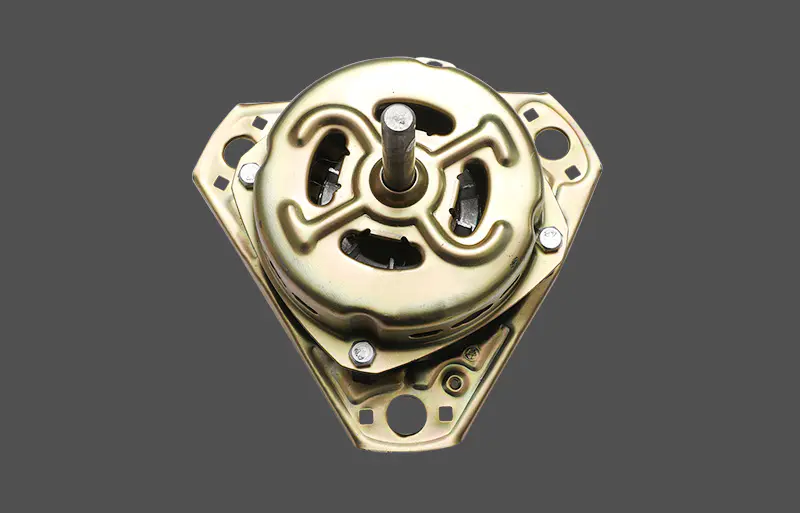
Ty001 Double-Tub Washing Machine Dedicated Motor
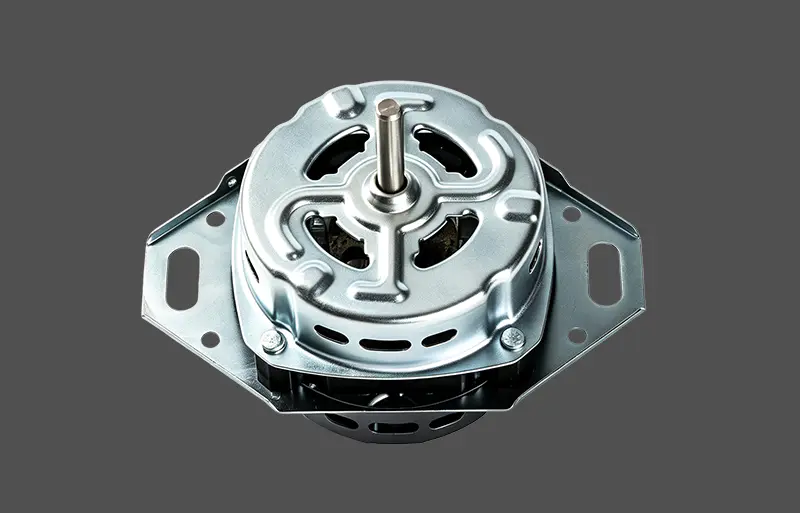
TY002 Powerful & Durable Copper-Wound Washing Machine Motor
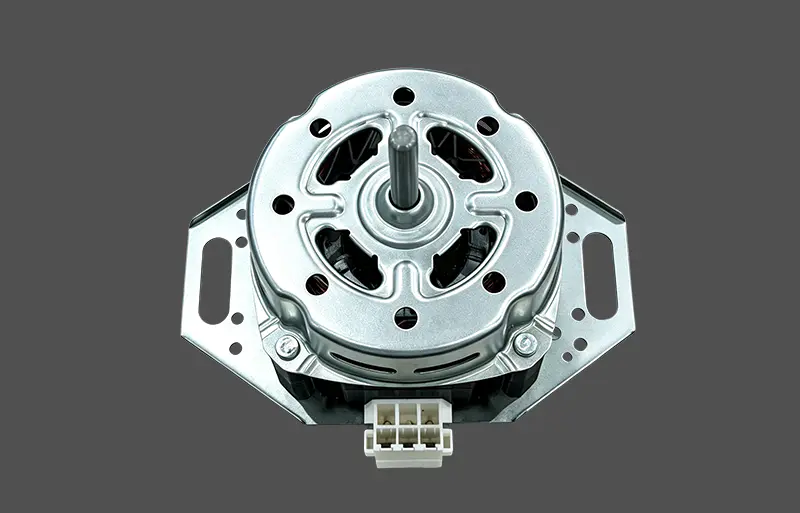
Environmental Cover Washing Machine Motor
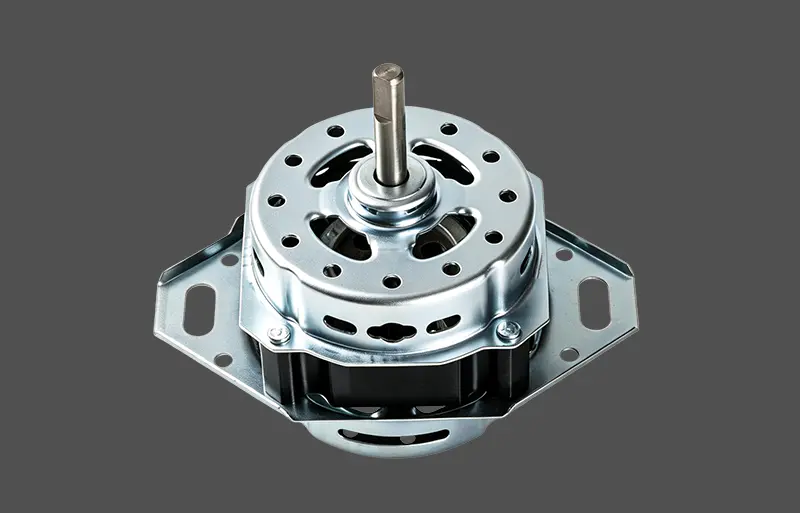
TY004 High-Efficiency Mini Copper Wire Washing Machine Motor
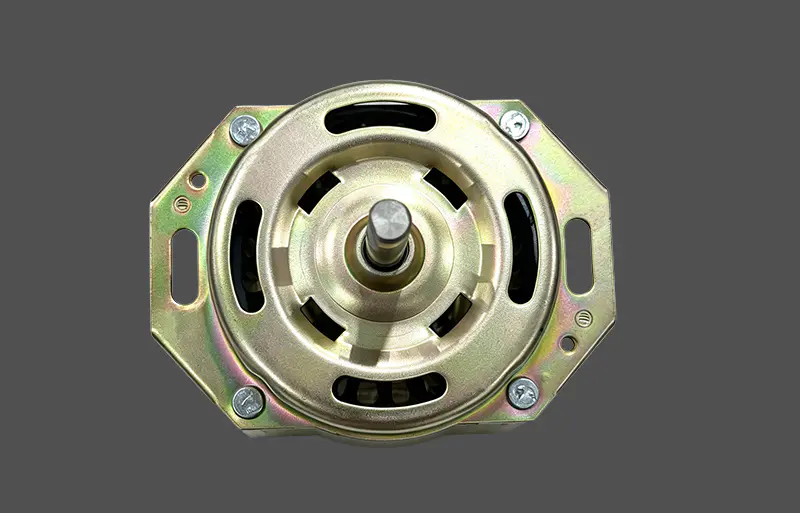
TY005 100% Copper Wire High-Speed Induction Motor
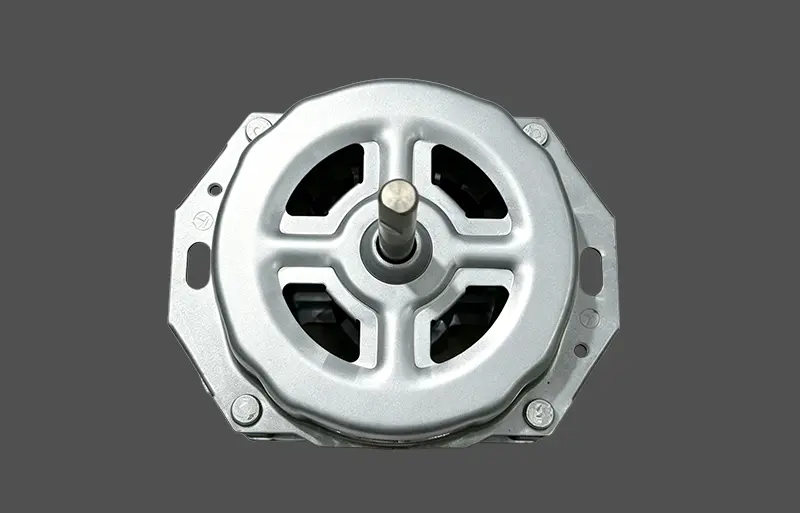
Home Appliance Parts Washing Motor
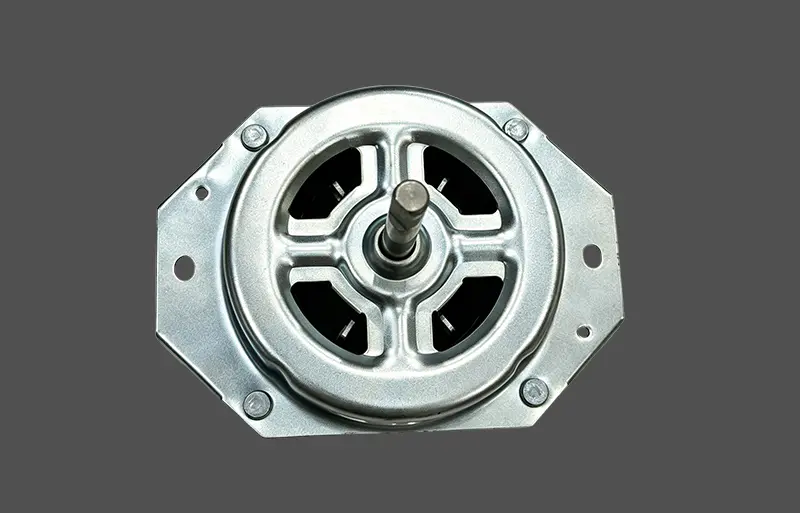
White Color CCA Motor
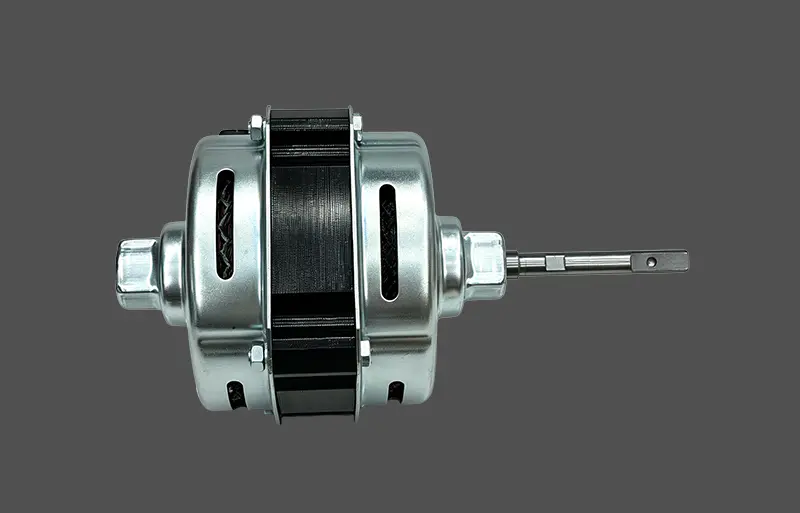
TY-008
Please leave your Email or phone nomber, so we can contact you as soon as possible.
Share


