What Household Appliances Use Electric Motors and Why

Update:14 Jul, 2026
Summary:
INDUSTRY TECHNICAL FEATURE

Electric Motors in Household Appliances: Types, Applications and Selection Factors

The electric motor for household appliances industry is a critical electromechanical component used to convert electrical energy into controlled rotary or linear motion. From refrigerators and washing machines to vacuum cleaners, range hoods and food processors, motor performance directly affects appliance efficiency, noise, service life and operating stability.

Motion Rotation, pumping, compression and airflow
Control Fixed speed, multi-speed and variable speed
Priorities Efficiency, noise, torque and durability
01 / BASIC FUNCTION

What Household Appliances Use Electric Motors?

Many everyday appliances depend on one or more motors. An electric motor may rotate a drum, drive a compressor, move air through a duct, operate a water pump, turn cutting blades or adjust an internal mechanism.

The question “what household appliances use electric motors” covers more products than visible rotating appliances. A refrigerator may use separate motors for the compressor, evaporator fan, condenser fan and ice-making mechanism. A washing machine may contain a drum motor, drain pump motor and water-control actuator.

Direct Answer

Household appliances that use electric motors include refrigerators, washing machines, dryers, vacuum cleaners, dishwashers, range hoods, air conditioners, electric fans, blenders, mixers, food processors, hair dryers, ventilation units, water pumps, robotic cleaners and powered kitchen equipment.

The correct motor type depends on the load. High-speed airflow equipment requires different speed and torque characteristics from a washing machine drum or refrigerator compressor.

Air Movement Fans, blowers and ventilation systems
Fluid Movement Pumps, circulation units and drainage systems
Mechanical Drive Drums, blades, rollers and transmission assemblies
Compression Refrigeration and air-conditioning compressors
02 / APPLICATION MAP

Household Items with Electric Motors

Motor applications can be grouped according to the type of movement required inside the appliance.

A

Refrigerators and Freezers

Refrigeration appliances commonly use a compressor motor to circulate refrigerant. Additional fan motors distribute cold air and remove heat from the condenser section.

Typical requirements Reliable starting, low vibration, stable continuous operation and thermal protection
B

Washing Machines

The main motor controls washing, reversing, spinning and braking. Modern designs may use direct-drive or belt-driven structures, depending on capacity and performance requirements.

Typical requirements High starting torque, speed control, low noise and resistance to moisture
C

Vacuum Cleaners

Vacuum cleaner motors operate at high rotational speeds to create pressure difference and suction airflow. Motor balance and cooling strongly influence sound and service life.

Typical requirements High speed, compact dimensions, strong airflow and effective heat dissipation
D

Kitchen Appliances

Blenders, mixers, grinders and food processors use motors to drive blades, gears or mixing tools. Starting torque is important when the appliance processes dense or heavy ingredients.

Typical requirements Short-time high torque, overload protection, speed adjustment and compact construction
E

Dishwashers

Dishwashers use circulation and drainage motors. The circulation motor moves water through spray arms, while a separate pump removes wastewater after each washing stage.

Typical requirements Water resistance, low noise, stable pumping pressure and repeated-cycle durability
F

Air Conditioners and Fans

Indoor and outdoor fan motors move air across heat exchangers. Compressor motors provide the main refrigeration work. Variable-speed control improves comfort and energy efficiency.

Typical requirements Efficient long-term operation, quiet speed control and stable performance under changing loads
03 / MOTOR TYPES

What Are the Three Types of Electric Motors?

Electric motors can be classified in several ways. For household appliance discussions, three broad groups are commonly used: AC induction motors, brushed motors and brushless motors.

TYPE 01

AC Induction Motor

An AC induction motor produces rotation through electromagnetic induction. It does not require brushes for current transfer to the rotor.

Common uses
Fans, pumps, compressors and selected washing appliances
Advantages
Simple structure, stable operation and limited routine maintenance
Considerations
Speed regulation may require additional electronic control
TYPE 02

Brushed Motor

A brushed motor uses brushes and a commutator to switch current through the rotating section. Universal motors can operate from AC or DC power.

Common uses
Vacuum cleaners, mixers, grinders, hair dryers and power-driven kitchen appliances
Advantages
High speed, strong starting torque and compact size
Considerations
Brush wear, electrical noise and higher operating sound
TYPE 03

Brushless Motor

A brushless motor uses electronic commutation instead of mechanical brushes. Permanent magnets are commonly incorporated into the rotor.

Common uses
Efficient fans, direct-drive washers, robotic cleaners and variable-speed pumps
Advantages
Higher efficiency, lower maintenance, accurate speed control and reduced mechanical wear
Considerations
Requires compatible electronic drive circuitry
04 / COMMON SELECTION

What Type of Motor Is Commonly Used in Household Appliances?

No single motor type is used in every household appliance. Manufacturers select motors according to speed range, torque, operating duration, noise target and product cost.

High-speed airflow or cutting
Universal or high-speed brushless motor Common in vacuum cleaners, mixers and compact airflow equipment
Continuous fan or pump operation
Induction, shaded-pole or brushless motor Selected according to efficiency, power and speed-control requirements
Precise variable-speed drive
Brushless DC or permanent-magnet synchronous motor Suitable for intelligent appliances requiring accurate electronic control
Low-power timing or positioning
Synchronous or geared motor Used for controlled rotation, timing mechanisms and small actuators
05 / PARAMETER COMPARISON

Motor Characteristics for Household Appliance Applications

Motor Type Speed Characteristics Starting Torque Noise Level Maintenance Typical Appliance Use
Universal motor Very high speed, easy electrical speed adjustment High Moderate to high Brush inspection may be required Vacuum cleaners, mixers, grinders and hair dryers
Induction motor Stable speed related to AC supply and motor design Moderate Low to moderate Generally low Pumps, fans, compressors and washing equipment
Brushless DC motor Wide variable-speed range with electronic control High and controllable Low Low mechanical maintenance Premium fans, robotic cleaners, pumps and direct-drive systems
Synchronous motor Operates at speed synchronized with the power frequency or electronic drive Low to moderate Low Low Timers, turntables, actuators and controlled-speed mechanisms
Shaded-pole motor Usually fixed low-power speed Low Low to moderate Low Small fans, evaporator airflow and compact ventilation units
Permanent-magnet synchronous motor Accurate variable speed with electronic drive High Low Low Efficient compressors, washing machines and advanced air-conditioning systems
06 / INDUSTRY REQUIREMENTS

Why Appliance Motors Require Application-Specific Design

A motor that performs well in one appliance may be unsuitable for another because the operating cycle, load and environmental conditions are different.

Torque Profile

Washing machines and food processors may require high torque at low or medium speed. Fans usually require lower starting torque but stable long-term rotation.

Operating Duty

Refrigerator compressors and ventilation fans may operate for long periods. Mixers and grinders normally operate in shorter cycles with higher intermittent loads.

Thermal Performance

Winding temperature, housing ventilation and insulation class influence motor reliability. Restricted airflow can cause rapid temperature rise.

Acoustic Performance

Bearing quality, rotor balance, electromagnetic design and mounting structure determine how much motor noise reaches the appliance enclosure.

Environmental Protection

Motors used near water, steam, grease or dust require suitable enclosure protection and sealing arrangements.

Motor Selection Is a System Decision

Motor power alone does not determine appliance performance. The motor must be evaluated with the impeller, gearbox, pump, blade, drum, controller and mechanical mounting.

Incorrect matching may cause low output, excessive current, vibration, overheating or premature bearing damage.

Load Requirement + Speed Range + Operating Duty + Control Method
07 / SPECIFICATION CHECKLIST

Important Parameters for an Electric Motor for Household Appliances Industry

Rated Voltage

Must match the appliance electrical system and target market power supply.

Rated Frequency

Important for AC motor speed, heating and electromagnetic performance.

Rated Power

Indicates output capability under specified operating conditions.

Rated Speed

Must correspond to the fan, pump, drum, blade or transmission requirement.

Starting Torque

Determines whether the motor can start the load without stalling.

Efficiency

Affects energy consumption, motor temperature and appliance operating cost.

Insulation Class

Defines the thermal endurance of the winding insulation system.

Protection Method

May include thermal protectors, fuses, current limits or controller-based protection.

Rotation Direction

Can be clockwise, counterclockwise or reversible according to the appliance mechanism.

Shaft Structure

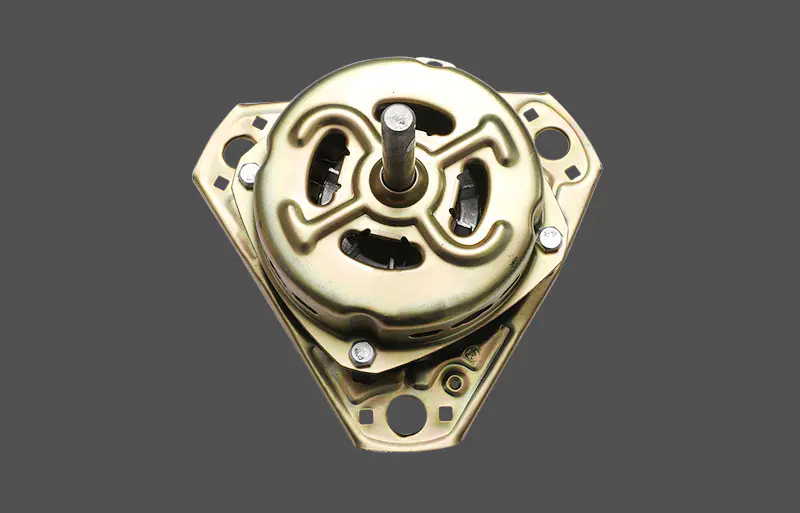
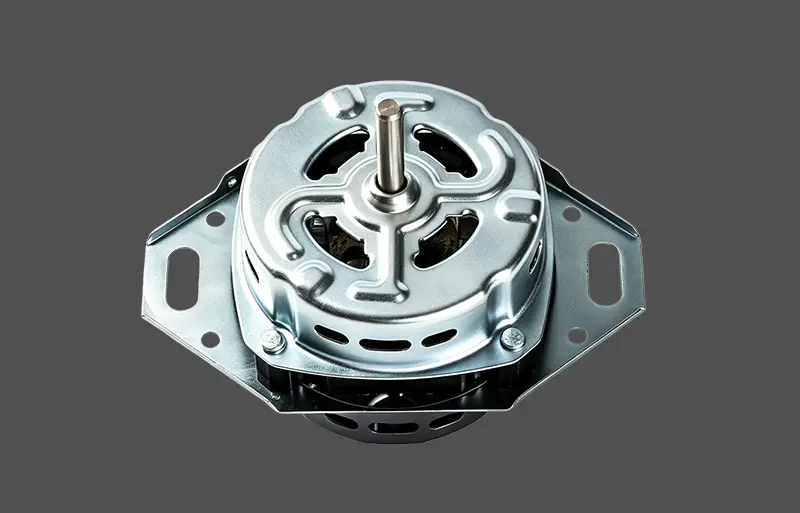
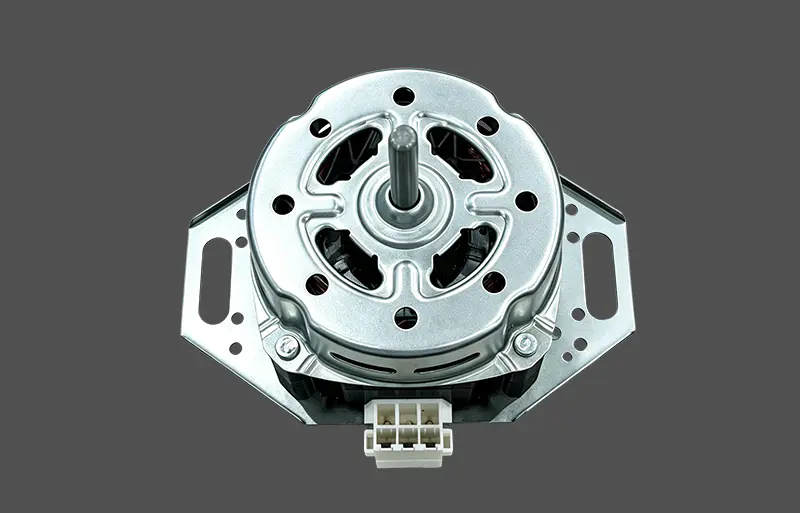
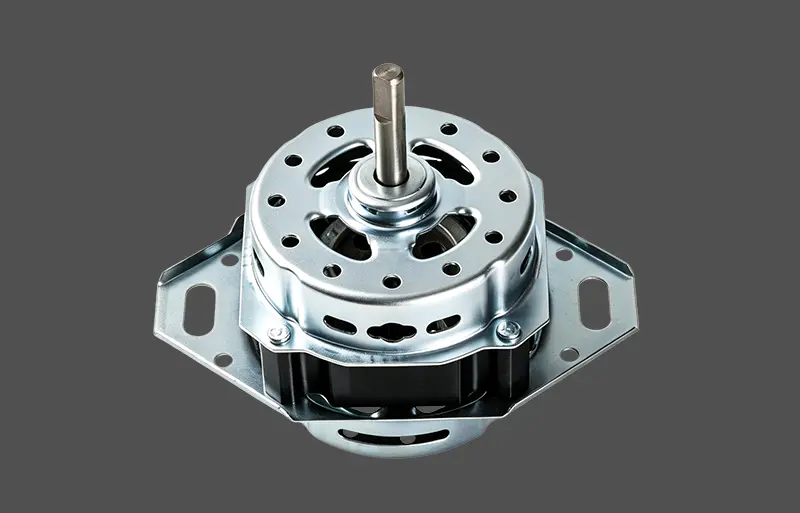
Diameter, length, flat surfaces, threads and coupling details must match the driven component.

Mounting Dimensions

Bracket position, hole spacing and housing geometry affect assembly compatibility.

Service Life

Influenced by bearings, brushes, thermal load, vibration and operating cycles.

08 / EFFICIENCY AND NOISE

How Motor Design Affects Appliance Efficiency and User Experience

The motor is one of the main sources of energy consumption, sound and vibration in many household appliances.

Energy Efficiency

Reducing Electrical and Mechanical Losses

Motor efficiency is affected by winding resistance, magnetic losses, rotor losses, bearing friction and cooling. Electronic control can reduce unnecessary power use by adjusting motor speed to the actual appliance load.

A variable-speed fan motor can operate at a lower speed when full airflow is not required. A direct-drive washing motor can reduce transmission losses by eliminating belts and pulleys.

Noise Control

Managing Airborne and Structural Sound

Motor noise may originate from bearings, brushes, electromagnetic forces, cooling airflow and rotor imbalance. Appliance housing can amplify vibration when mounting points are too rigid or poorly positioned.

Noise reduction may involve rotor balancing, suitable bearing selection, optimized electromagnetic design, resilient mounting and controlled acceleration.

09 / EDUCATIONAL MOTOR PROJECTS

A Simple Electric Motor Made from Household Materials

A simple electric motor made from household materials is often used to demonstrate the relationship between electric current, magnetic fields and rotational force. A basic classroom model may use insulated copper wire, a small permanent magnet, simple supports and a low-voltage battery.

The wire coil carries current and becomes an electromagnet. Interaction between the coil field and permanent magnet field creates force that can rotate the coil when the electrical contact is arranged correctly.

This experiment explains the basic principle of electromagnetic motion, but it does not reproduce the construction, insulation, control, bearing system or protection features of a household appliance motor.

Safety Boundaries

Educational motor demonstrations should use only a suitable low-voltage power source. Household mains electricity must not be used.

The wire and battery can become hot if a short circuit occurs. The circuit should be disconnected immediately after the demonstration.

Children should complete the activity only with appropriate adult supervision.

10 / SYNCHRONOUS MOTOR

A Simple Synchronous Electric Motor Made from Household Materials

A synchronous motor follows the rotational speed of a changing magnetic field. Building a true synchronous motor requires more control than a basic battery-powered coil experiment.

Basic principle

A rotating or alternating magnetic field acts on a magnetic rotor. When the rotor locks into the magnetic field sequence, it rotates at synchronous speed.

Household demonstration limitation

A simple demonstration may show magnetic alignment or step-by-step rotor movement, but it may not maintain stable synchronous operation without a controlled alternating supply.

Appliance relevance

Small synchronous motors are used in timing mechanisms, turntables, dampers and low-power positioning systems where stable speed is important.

Electronic synchronous drive

Modern permanent-magnet synchronous motors use electronic controllers to regulate phase sequence, torque and speed with high efficiency.

11 / TROUBLESHOOTING

Common Motor Symptoms in Household Appliances

Motor does not start
Power interruption, controller fault, thermal protector operation, seized load or damaged winding
Check the power source, load movement, connectors and protection status
Motor hums but does not rotate
Locked mechanism, failed start capacitor, insufficient voltage or excessive load
Disconnect power and inspect the driven mechanism before further testing
Unusual vibration
Rotor imbalance, worn bearing, loose mounting, damaged fan or misaligned coupling
Inspect mounting points and rotating components for looseness or damage
Excessive temperature
Overload, blocked ventilation, low voltage, repeated starting or internal electrical fault
Stop operation and identify the source of heat before restarting the appliance
Reduced speed or output
Worn brushes, controller limitation, high friction, low supply voltage or incorrect load matching
Compare the operating condition with the rated motor and appliance specifications
12 / PRACTICAL QUESTIONS

Questions About Household Appliances That Use Electric Motors

What household items have electric motors?

Common household items with electric motors include refrigerators, washing machines, dryers, vacuum cleaners, fans, air conditioners, dishwashers, range hoods, blenders, mixers, hair dryers, pumps and robotic cleaning equipment.

Why do some appliances contain more than one motor?

Different functions require independent motion. A dishwasher may use separate motors for water circulation and drainage. A refrigerator may use a compressor motor and several fan motors.

Which motor is best for quiet household appliances?

Brushless and well-designed induction motors can provide low-noise operation, but the complete result also depends on bearings, rotor balance, control strategy and appliance mounting.

Why are brushless motors used in modern appliances?

Brushless motors support efficient variable-speed operation, reduced mechanical wear and accurate electronic control. They are useful in intelligent appliances with multiple operating modes.

Can an appliance motor run continuously?

Continuous operation is suitable only when the motor is designed for the required duty, cooling condition and load. Duty rating and thermal protection should be confirmed.

Does a higher wattage motor always provide better performance?

No. Appliance output depends on efficiency, torque, speed, load matching and mechanical design. An oversized motor can increase energy use, noise and product dimensions without improving useful output.

What causes electric motor noise in household appliances?

Noise can be produced by bearings, brushes, magnetic forces, airflow, loose mounting, worn couplings or an unbalanced rotating load.

Can one motor model be used in different appliances?

A motor can sometimes be adapted to related applications, but shaft design, voltage, speed, torque, mounting, controller compatibility and protection must all match the final appliance.

APPLIANCE MOTOR CONFIGURATION

Match Motor Performance to the Appliance Load

Selecting an electric motor for household appliances requires clear information about the driven component, working cycle, speed range, starting load, installation dimensions and electrical control system.

Application Fan, pump, compressor, drum, blade or transmission
Electrical Data Voltage, frequency, phase, power and controller type
Mechanical Data Shaft, mounting, rotation direction and connection method
Operating Data Speed, torque, duty cycle, temperature and noise target
Information for motor matching

Provide the appliance type, motor installation drawing, rated power supply, required speed, torque condition, shaft dimensions, daily operating time, environmental conditions and expected production quantity.