


Two workshops of the same size, in the same industrial park, running the same summer shift pattern, can differ by two thousand kilowatt hours a month on ventilation alone. The building on the left runs belt-driven axial exhaust fans built in 2009, at full speed, from the first shift to the last. The building on the right runs direct-drive units of the same nominal air volume, started at 70 percent speed and ramped up only when the temperature climbs past 30 degrees Celsius. The airflow on paper looks almost identical. The meter readings do not.
So do industrial fans use a lot of power? The direct answer is this: a small axial fan uses very little, a large centrifugal blower uses a great deal, and almost every fan in between can be made to consume 20 to 50 percent less than it does today without losing the air the process actually needs. Typical figures look like this. A 400 mm axial wall fan draws 100 to 400 W. A 500 mm square-frame ventilation fan draws 370 W to 1.5 kW. A large axial flow fan in a warehouse draws 3 to 22 kW. A high-pressure centrifugal blower can reach 55 to 75 kW, which is roughly 1,800 kWh across a single eight-hour working day.
Whether that number matters depends on five variables: the airflow the space genuinely requires, the static pressure the system has to overcome, the efficiency of the motor, the speed the impeller turns at, and the number of hours the fan runs each year. Move any one of them and the power figure changes. Move speed and it changes dramatically.
Fan power is not fixed by a size label on a catalogue page. It is set by the duty point you ask the fan to work at, and by how carefully that duty point was chosen.
Fan power ratings are usually quoted as motor input power at one specific duty point, not as an average for a working day. That single fact explains most of the confusion around this question. The ranges below come from common exhaust, ventilation and cooling applications. They are useful for quick estimates before anyone puts a clamp meter on the supply cable.
| Fan type | Typical motor input power | Indicative airflow | Duty note |
|---|---|---|---|
| Axial wall and exhaust fan, 300-400 mm | 0.10-0.40 kW | 1,500-4,000 cubic metres per hour | Free blowing or short duct runs; lowest power per unit of air |
| Inline diagonal duct fan, 200-315 mm | 0.25-1.10 kW | 800-3,500 cubic metres per hour | Works against 150-450 Pa of static pressure |
| Square-frame industrial ventilation fan, 500-630 mm | 0.37-1.50 kW | 6,000-12,000 cubic metres per hour | Workshop extract, welding bays, general dilution |
| Mobile evaporative air cooler with EC motor | 1.10-2.20 kW | 12,000-20,000 cubic metres per hour | Spot cooling in open halls and semi-open workshops |
| Large axial flow fan, 630-1,000 mm | 3.0-22 kW | 20,000-60,000 cubic metres per hour | High-volume extract, paint booths, tunnel ventilation |
| Centrifugal blower, high pressure | 7.5-75 kW | Duty dependent | Long duct networks, filters, scrubbers, pneumatic conveying |
Three observations matter more than the raw numbers. First, the gap between the smallest and largest item on that list is roughly 700 to 1, which is why a single blanket answer to this question is impossible. Second, the units that look expensive per cubic metre of air are usually the ones fighting high static pressure; a ducted fan pushing against 400 Pa cannot be compared with a free-blowing wall fan of the same motor size. Third, airflow figures are meaningless without the pressure at which they were measured. A unit rated 8,000 cubic metres per hour at free air may deliver 3,500 once it is connected to a long duct run with bends, filters and a shutter.
It also helps to compare like with like. An industrial fan and an ordinary electric fan solve different problems, even if both move air. The industrial unit is built for continuous duty, higher ambient temperatures, higher pressure and thousands of running hours per year. A domestic fan moving 45 W of power for three hours a night is not a useful benchmark for a machine that runs unattended from Monday morning to Saturday night.
The relationship between speed and power is the most useful piece of engineering knowledge in any discussion about fan electricity use. For a fixed system with unchanged resistance, airflow rises in direct proportion to speed, static pressure rises with the square of speed, and shaft power rises with the cube of speed. That is not a marketing claim; it comes from the fan affinity laws that have governed air movement machinery for more than a century.
| Speed as a percentage of rated | Airflow | Static pressure | Shaft power | Power for a 1.5 kW fan |
|---|---|---|---|---|
| 100 percent | 100 percent | 100 percent | 100 percent | 1.50 kW |
| 90 percent | 90 percent | 81 percent | 73 percent | 1.09 kW |
| 80 percent | 80 percent | 64 percent | 51 percent | 0.77 kW |
| 70 percent | 70 percent | 49 percent | 34 percent | 0.51 kW |
| 60 percent | 60 percent | 36 percent | 22 percent | 0.32 kW |
| 50 percent | 50 percent | 25 percent | 13 percent | 0.19 kW |
Read the last column again. Cutting speed by 20 percent removes about half the power. Cutting speed by half removes almost 90 percent of it. This is why variable frequency drives and multi-speed motors pay for themselves so quickly in ventilation systems where the full airflow is needed for only two or three hours a day.
Three practical caveats keep this honest. First, the affinity laws assume the system resistance curve does not change; a damper that is half closed changes it and wastes the saving. Second, motors cooled by their own shaft-mounted fans lose cooling capacity at very low speeds, so most drives are programmed with a minimum frequency of 20 to 30 Hz. Third, if two fans work in parallel on the same duct, reducing both to 70 percent does not simply deliver 70 percent of the airflow, because the shared duct system shifts the operating point. Measure the result rather than assuming it.
Two fans can produce identical airflow at identical static pressure and still differ by 15 percent on the electricity meter. The difference sits in the motor behind the impeller, in the winding material, and in how much of the electrical input is converted into rotation instead of heat.
| Efficiency class | Approximate efficiency at 0.75 kW | Approximate efficiency at 11 kW | Relative internal losses |
|---|---|---|---|
| IE1 standard efficiency | Around 72 percent | Around 87 percent | Baseline |
| IE2 high efficiency | Around 79 percent | Around 90 percent | Roughly 25 percent lower |
| IE3 premium efficiency | Around 82 percent | Around 91.5 percent | Roughly 45 percent lower |
| IE4 super premium efficiency | Around 87 percent | Around 93 percent | Roughly 60 percent lower |
On a 0.75 kW fan running 4,000 hours a year, the step from IE1 to IE3 saves roughly 350 kWh annually. On an 11 kW blower running two shifts, the same step saves more than 4,000 kWh. The larger the motor and the longer the running hours, the more the efficiency class matters relative to the purchase price.
Beyond the efficiency class, four details decide how a fan motor behaves in real service. Copper windings rather than aluminium reduce resistance losses and run cooler at the same load. A correctly matched run capacitor keeps the auxiliary winding current in phase and prevents the motor from drawing more current than the nameplate suggests. Bearing quality determines friction losses and noise, both of which rise steadily as bearings wear. Thermal margin determines whether the motor can survive a 45 degree Celsius workshop in August without derating.
This is the point where the specification of ventilator motors stops being a purely technical question and becomes a running-cost question. A motor selected for continuous duty at the actual duty point, rather than one selected on price alone, is usually the cheapest component in the ventilation system over a five-year period.
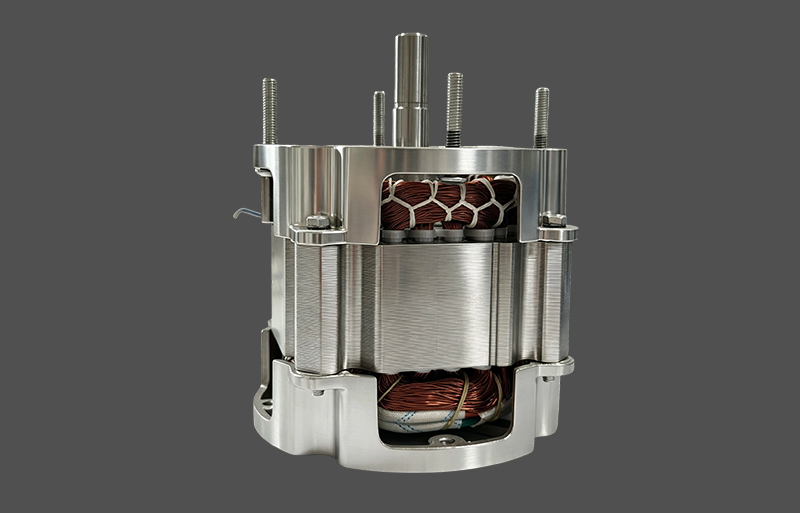 Open-Frame Industrial Ventilator MotorThis professional-grade ventilator motor is specifically engineered for high-intensity industrial environments. Due to its open-frame structural advantage, it is widel...View Product →
Most arguments about fan electricity use would disappear if everyone read the nameplate the same way. The plate on the motor gives you the information needed to calculate input power, provided you understand which number is input and which is output.
For a three-phase motor, input power in kilowatts is calculated as the square root of three, multiplied by voltage, multiplied by current, multiplied by power factor, divided by one thousand. A 380 V motor drawing 3.5 A at a power factor of 0.82 therefore consumes about 1.89 kW at that operating point. For a single-phase motor, the same calculation drops the square root of three entirely.
| Nameplate entry | What it actually tells you | Common misreading |
|---|---|---|
| Rated voltage and frequency | The supply the motor was designed for | Assuming a 50 Hz motor will behave identically on 60 Hz |
| Rated current | Current at rated load, not at every load | Multiplying current by voltage and calling it the running cost |
| Rated output power | Shaft power delivered to the impeller | Treating it as the electricity drawn from the socket |
| Power factor | The phase relationship between voltage and current | Ignoring it entirely, which inflates the estimate by 10 to 20 percent |
| Insulation class | Thermal capability of the winding system | Confusing it with enclosure protection |
| Duty rating | Whether continuous running is permitted | Assuming every fan motor can run 24 hours a day |
| IP rating | Protection against dust and water ingress | Assuming a higher IP number automatically means higher efficiency |
In practice, a fan rarely draws its rated current. Once the impeller is fitted and the system resistance is lower than the design maximum, the motor runs at perhaps 60 to 80 percent of rated load. That is good news for the bill and bad news for anyone who sizes a generator or a cable based on nameplate current alone. A clamp meter reading taken on the supply cable during normal operation is the only reliable figure, and it costs less than an hour of an electrician's time.
The calculation that convinces most buyers is not watts, it is currency. The table below assumes eight hours of operation per day, 250 working days per year, and three different electricity tariffs. Adjust the tariff to your own region and the pattern holds.
| Motor input power | Annual consumption | Cost at 0.10 USD per kWh | Cost at 0.15 USD per kWh | Cost at 0.25 USD per kWh |
|---|---|---|---|---|
| 0.25 kW | 500 kWh | 50 USD | 75 USD | 125 USD |
| 0.55 kW | 1,100 kWh | 110 USD | 165 USD | 275 USD |
| 1.1 kW | 2,200 kWh | 220 USD | 330 USD | 550 USD |
| 4 kW | 8,000 kWh | 800 USD | 1,200 USD | 2,000 USD |
| 22 kW | 44,000 kWh | 4,400 USD | 6,600 USD | 11,000 USD |
| 55 kW | 110,000 kWh | 11,000 USD | 16,500 USD | 27,500 USD |
Two conclusions follow. Small fans are almost never a cost problem; the annual bill for a 250 W unit is less than the cost of the maintenance visit that checks it. Large fans are a cost problem the moment they are oversized, throttled or run when the space is empty. In factories where ventilation runs around the clock regardless of occupancy, the annual bill for a single 22 kW unit can exceed the price of the fan by a factor of five within three years.
Power consumption in isolation says very little. A fan that draws 15 kW and moves 120,000 cubic metres per hour may be far more efficient than one that draws 0.5 kW and moves 900 cubic metres through a narrow duct. The meaningful metric is air delivered per unit of energy, and it is usually written as cubic metres per hour per kilowatt.
| Application | Typical airflow per kW | Why the figure looks this way |
|---|---|---|
| Free-blowing axial wall fan | 14,000-20,000 cubic metres per hour per kW | Almost no resistance; the impeller works near its best point |
| Square-frame industrial extract fan | 9,000-13,000 cubic metres per hour per kW | Short duct runs and shutters add modest pressure |
| Inline duct fan at 300 Pa | 3,000-6,000 cubic metres per hour per kW | Pressure is the price of moving air through pipework |
| Centrifugal blower at 1,500 Pa | 1,500-3,500 cubic metres per hour per kW | High pressure duty such as filters, scrubbers or long networks |
| Large mobile cooling fan | Airflow alone does not describe the result | Cooling effect and air velocity at the workstation matter more |
The comparison with compressor-based cooling is where these numbers become commercially interesting. A workshop of 1,000 square metres cooled by conventional split systems may need 40 to 60 kW of connected compressor capacity. The same space served by a combination of large low-speed circulation fans and evaporative coolers typically needs 5 to 15 kW of connected load. The airflow is different, the comfort is different, and the electricity bill is, on average, four to eight times lower.
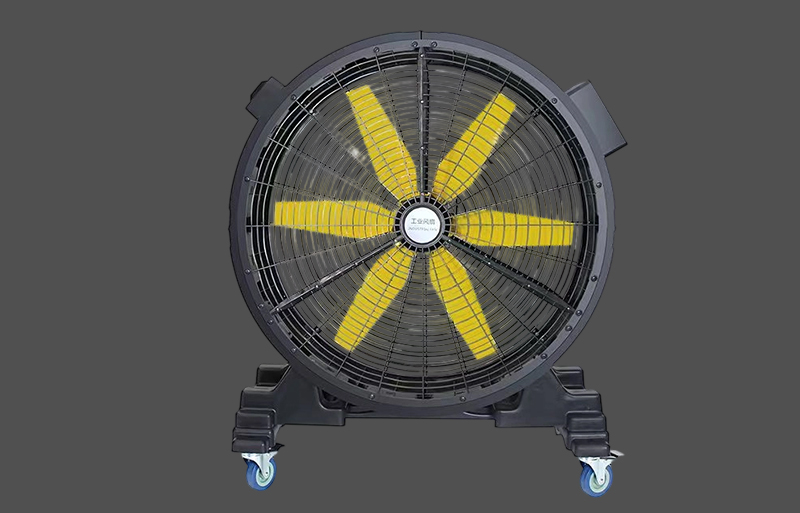 ZP-Series Industrial Cooling Large Scale FanThis is a multi-functional cooling device that integrates powerful air delivery with fine atomization. it is particularly suitable for high-temperature foundries, outd...View Product →
Air velocity at the worker is the variable that ties this together. Body cooling depends on air speed across the skin, not on the total volume of air in the building. This is why a large fan turning slowly can replace several smaller fans turning quickly, and why the total installed power falls even though the perceived cooling improves.
Even a premium efficiency motor cannot rescue a badly designed air path. Between 10 and 35 percent of fan energy is typically lost in places that have nothing to do with copper windings.
None of these faults shows up on a specification sheet. All of them show up on a meter reading, and most of them can be found during a single walk-through with a clamp meter and a handheld anemometer.
Reducing fan electricity use is rarely about buying a different fan. It is about matching the fan to the job and then letting it slow down when the job is done.
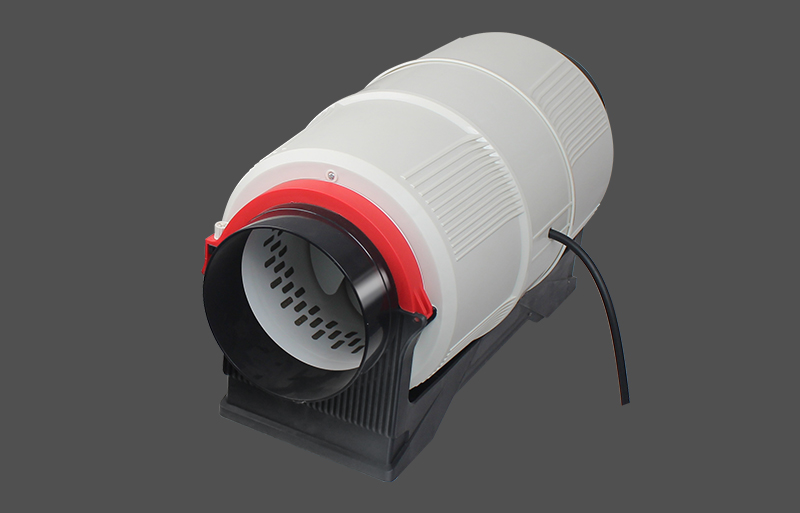 ZB-Series Diagonal Flow Low-Noise Silent Inline FanThis silent fan is crafted for indoor environments with strict acoustic requirements, such as luxury hotel rooms, high-end meeting rooms, precision laboratories, libra...View Product →
Ducted installations deserve particular attention because they combine pressure losses with long running hours. Low-noise diagonal flow inline fans are a useful middle ground: they hold airflow reasonably well against 150 to 400 Pa without the power penalty of a high-pressure centrifugal machine, and their lower noise level often allows them to run at higher speed in occupied areas without complaints.
A fan that drew 1.4 kW when it was commissioned can quietly rise to 1.8 kW over three years without any visible fault. The increase comes from accumulated mechanical and aerodynamic losses, and it is reversible.
These tasks take a few hours a year. On a 7.5 kW unit running two shifts, keeping the fan at its commissioning current is typically worth several hundred kilowatt hours annually, which is more than the cost of the maintenance itself.
Many can, but not all, and the difference is written on the motor rather than in the marketing material. Motors rated for continuous duty, usually marked S1, are designed to reach thermal equilibrium and stay there indefinitely. Motors rated for intermittent duty are not, and running them continuously causes insulation degradation that appears as a failure long after the warranty has expired.
The second consideration is ambient temperature. A motor rated for 40 degrees Celsius ambient will run hotter than its design point in a foundry or a boiler room, and its insulation life shortens accordingly. Motors intended for those environments are specified with higher insulation classes and often with external cooling arrangements.
The third consideration is cost. A 1.1 kW fan running 24 hours a day, 365 days a year consumes 9,600 kWh. A 22 kW fan under the same schedule consumes 193,000 kWh. Overnight operation is therefore reasonable for a small exhaust fan in a space that needs constant air change, and questionable for a large cooling fan in an empty warehouse. Timers, sensors and two-speed control resolve the question without any technical risk.
100-400 W
Typical 300 to 400 mm wall or panel fan. Annual cost measured in tens of units of currency, not thousands.
0.37-1.5 kW
Square-frame and portable ventilators for general dilution and spot extraction.
50 percent
The cube law turns a modest speed reduction into a large reduction in consumption.
3-22 kW
High-volume extract and tunnel ventilation, where running hours decide the bill.
10-15 percent
The difference between a standard and a premium efficiency motor at the same duty point.
7.5-75 kW
Long duct networks, filters and process air, where pressure dominates power demand.
Almost never for the same area. A single 3.5 kW split air conditioner draws more power than six typical 500 mm ventilation fans combined. The comparison only changes when a very large high-pressure blower is involved, and even then the fan usually serves an industrial process that an air conditioner could not perform at all.
Between 100 W for a small axial wall fan and several hundred kilowatts for the largest process blowers. For the majority of factory and warehouse ventilation duties, the realistic range is 370 W to 4 kW. That covers exhaust fans, square-frame ventilators, ducted units and large mobile cooling fans.
No. A large fan turning slowly can move the same air as several small fans turning quickly, while drawing less power in total. Bigger impellers are generally more efficient per cubic metre of air because they move air at lower velocity and with less friction. What raises power is speed and pressure, not diameter by itself.
For a 0.55 kW unit, an overnight run of eight hours costs roughly the price of a cup of coffee. For a 22 kW unit, the same night costs more than a full day of a maintenance technician. The sensible approach is to base overnight running on actual need, and to use a timer or a speed controller to match output to occupancy.
Motors marked for continuous duty are designed to run indefinitely at their rated ambient temperature. Overheating usually comes from three sources: a duty rating that does not permit continuous running, an ambient temperature above the design value, or restricted ventilation around the motor body because of dust or poor installation.
Speed control, provided the airflow requirement genuinely varies. After that, the sequence is: correct sizing, low static pressure in the duct design, an efficient motor, demand-based switching, and disciplined maintenance. In a typical installation, the first two measures together deliver more savings than everything else combined.
Often yes. Fitting a premium efficiency motor, cleaning and balancing the impeller, correcting belt alignment and adding a variable frequency drive can reduce consumption by 20 to 40 percent at a fraction of the cost of a new unit. Replacement makes more sense when the fan casing is corroded, the impeller is damaged, or the original unit was substantially oversized.
Measure it. A clamp meter on the supply cable during normal operation gives the running current, and multiplying that by the supply voltage and power factor gives input power. Compare the result with the nameplate and with the commissioning record. If the current has risen since installation, the cause is mechanical or aerodynamic, and it can usually be corrected.
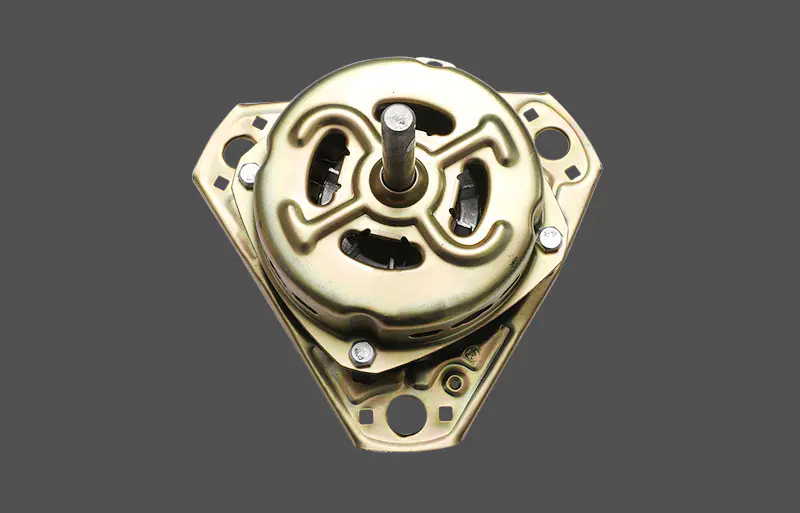
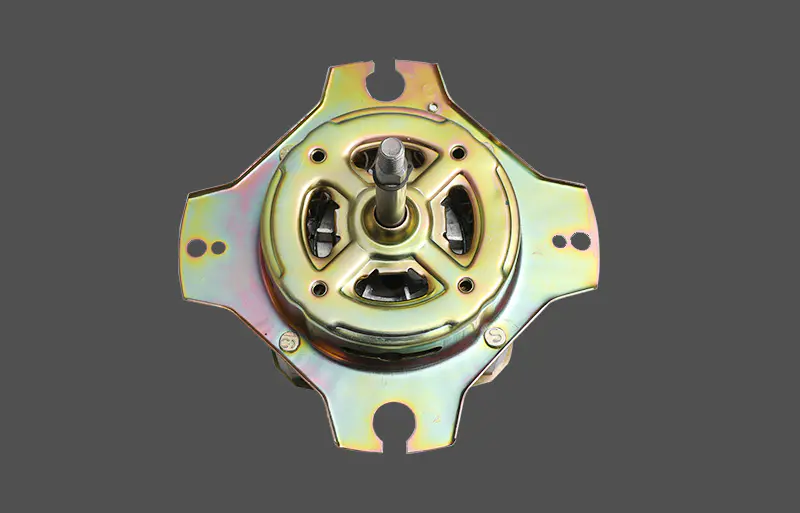
Ty001 Double-Tub Washing Machine Dedicated Motor
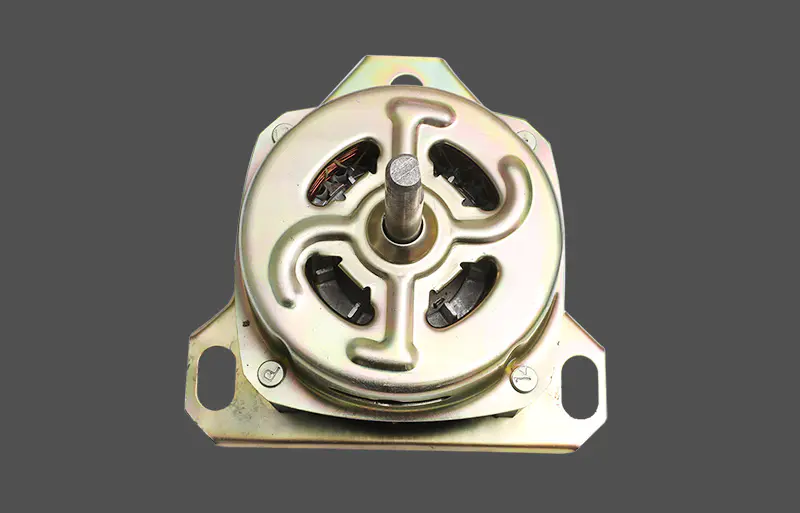
TY002 Powerful & Durable Copper-Wound Washing Machine Motor
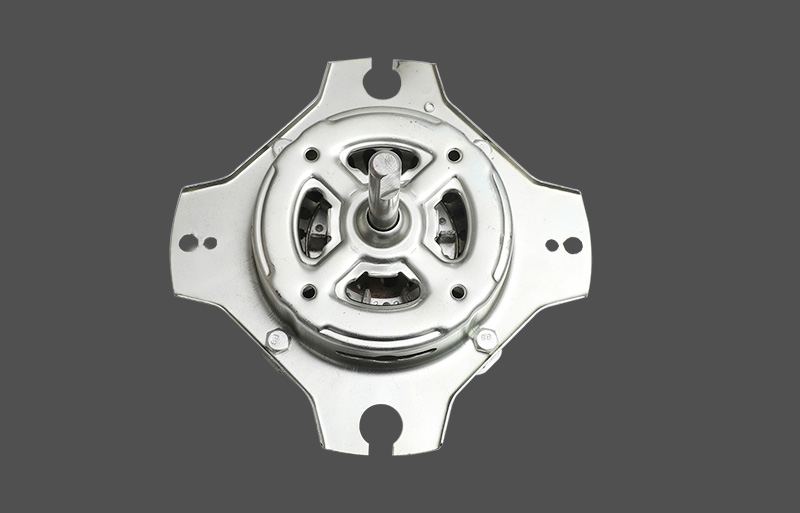
Environmental Cover Washing Machine Motor
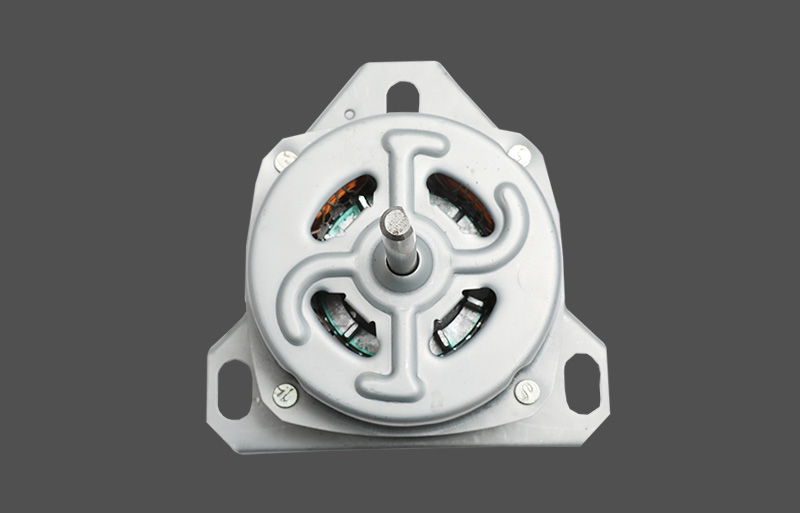
TY004 High-Efficiency Mini Copper Wire Washing Machine Motor
TY005 100% Copper Wire High-Speed Induction Motor
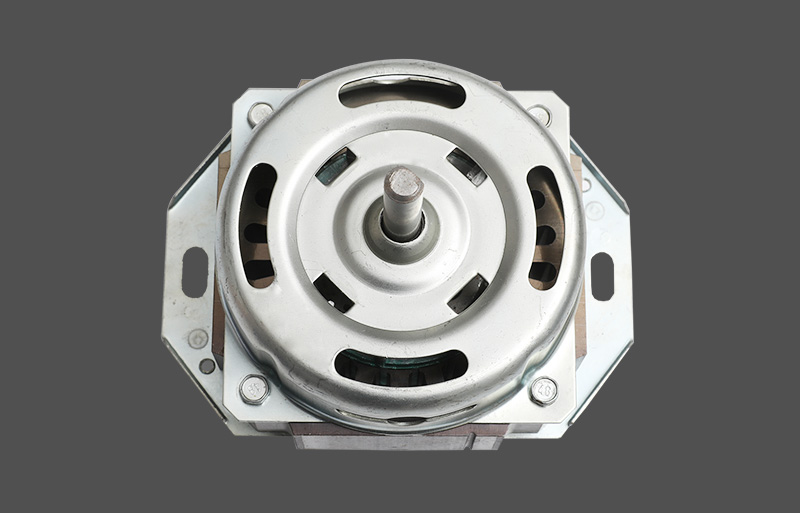
Home Appliance Parts Washing Motor
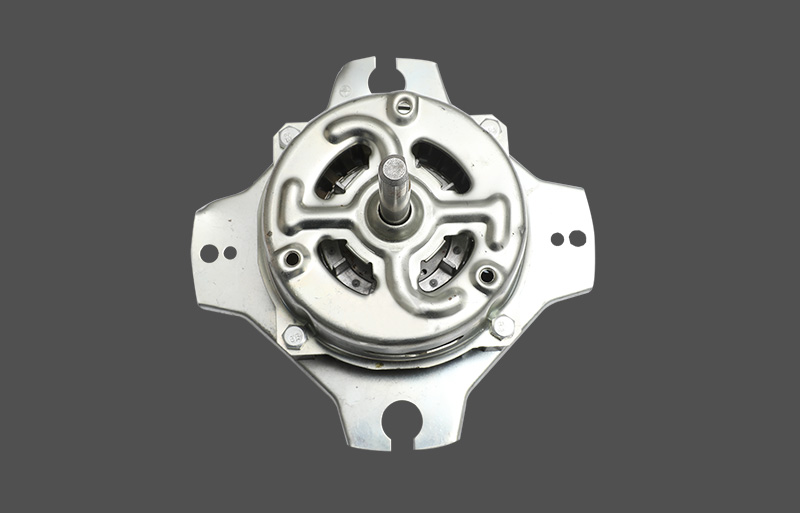
White Color CCA Motor
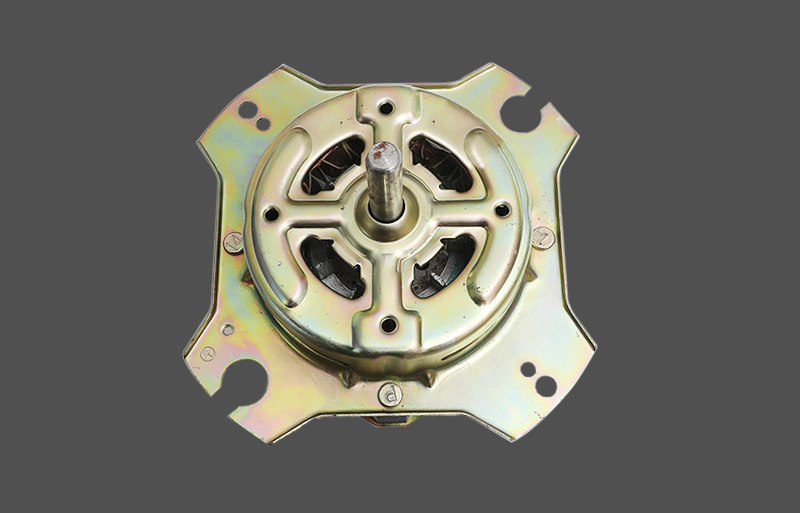
TY-008
Please leave your Email or phone nomber, so we can contact you as soon as possible.
Share


